 | Donate Now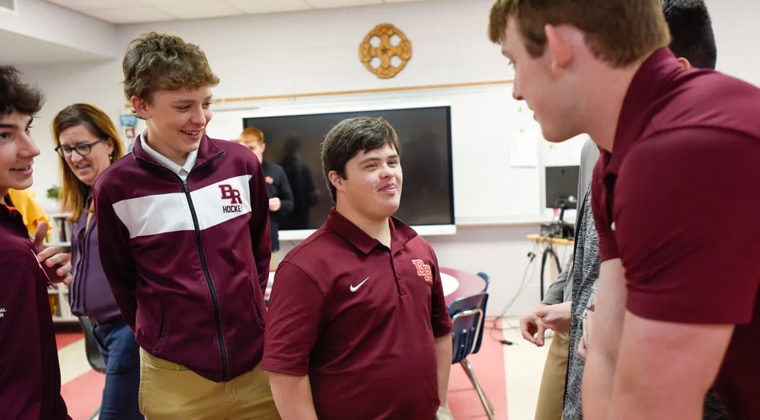
The fluorescent lights in Room 110 at Brother Rice Catholic High School in Chicago are dimmed by fabric imprinted with images of the sky. The white-and-blue design softens the light, making it more comfortable for the students who study there. Chairs have elastic bands stretched across their front legs so students can push against them to relieve tension.
The room is home to Mount Sion, the all-boys-school’s special education inclusion program, which is entering its third year this fall. Brother Rice is among a small but growing number of Catholic schools across the country working to serve students with intellectual and developmental disabilities.
A 2026 survey by the National Catholic Partnership on Disability found that roughly 18 percent of the school principals said that their school has served at least one student with an intellectual disability. Disability advocates, however, point out that the figure may not capture the national reality, since only 224 institutions responded to the survey, far short of the approximately 5,800 Catholic schools in the United States. Data like this can be hard to interpret in part because schools define the work differently.
“Sometimes schools are serving many students [with learning disabilities] but they haven’t named it, they haven’t labeled it,” according to Laura MacDonald, vice president of content and program development at the National Catholic Educational Association. “Schools just do it. Many of us believe that whoever comes into your school, you’re there to serve them.”
In 2014, 3.5 percent of students in N.C.E.A. schools were reported as having been diagnosed with a disability. Today that figure is 9.8 percent. Ms. MacDonald said N.C.E.A. has established a task force that is developing a directory of schools with promising programs.
Some schools lean toward a more segregated model, in which special needs students remain mostly in their own classrooms, while others adopt a more integrated approach. Then there are the rare U.S. Catholic schools that serve only students with intellectual and developmental disabilities. The students’ abilities span a wide spectrum.
“We see good things happening in pockets,” according to Michael Boyle, executive director of the Herrmann Center for Innovative Catholic Education at St. Louis University. “And I think that’s part of the problem. As a universal church, we should be seeing something much more comprehensive and extensive.”
Still, a number of schools and dioceses are making an effort, Mr. Boyle said, noting the autism program at the St. Nicholas of Tolentine elementary school in Chicago as well as efforts in Arlington, Va., Milwaukee and Miami. N.C.E.A. is partnering with Getting Real Access to Catholic Education, which promotes inclusion at Catholic schools, and St. Louis University hosted what it called the first-ever national convening on disability and Catholic education in May 2025.
Nevertheless, most families who search for a Catholic education for a child with a disability will have a hard time finding it. And when a Catholic school rejects a student’s application, Mr. Boyle said, the family may also feel rejected by their faith community.
“As Catholic educators, as all Catholics, we are charged to reach to the margins and serve those that are marginalized,” he said. “We sometimes have forgotten that. We need to think about who we are as Catholic educators.”
At Brother Rice, the rediscovery began after one family spoke up and stood its ground.
‘The Essence of Who We Are’
On Chicago’s South Side, Catholics tend to identify themselves by their home parish. For the Baudo family, that parish is St. Barnabas. Kerry and Rich Baudo’s firstborn son, Nolan, attended the parish school. Nolan’s younger brother Parker did as well, though this was a little more complicated.
Parker has Down syndrome. After he attended a supportive preschool, the family wanted him to go to St. Barnabas, where not only his brother but also his cousins, his friends and most of the other kids in the neighborhood went. Everyone, from the principal to the pastor, pitched in to make it happen.
“We kind of co-created a program leveraging as many resources as we could to give him a real community experience,” Mr. Baudo said. “We were building the plane while flying it.”
He added, “the kids embraced him from the outset. And that’s where we really saw his impact on them as much as they impacted him.”
As Parker grew up, the family started looking for Catholic high school options. The only school that could accommodate their son’s needs was Notre Dame High School in Niles, a 90-minute drive north. The public schools in their area also fell short, as they segregated the special needs students from the general student population, and Parker was not used to that.
The Baudos got a few flyers from Brother Rice in the mail, but as far as they could determine, it would not be an option for Parker. They asked to be removed from the mailing list. They didn’t want to get Parker’s hopes up. Nevertheless, a week or so later, Parker found a flyer from Brother Rice addressed to him in the mailbox.
“I got upset and wrote an email,” Rich said. “I just said, ‘I get that you guys can’t accommodate him, but take him off the list, because I can’t have his name on a Brother Rice [flyer] and then have him start asking questions I can’t answer.’”
After the flyer mishap, Greg Nye, the director of admissions, and Matt Prunckle, dean of student life, invited the family to talk. Administrators had been considering starting a program to accommodate students with special needs, they said, but it wasn’t fully formed.
“We spent the last nine years pushing the boulder up the hill,” Mr. Baudo recalls telling the school. “We can’t do that for high school. There has to be more structure, a more established program—because those high school years are so critical.” The school agreed.
Five months later, the school’s board approved the Mount Sion program.
“Any inclusive school that’s opted in [to serving students with special needs] will always say it’s the best thing they’ve done,” Mr. Prunckle said. “It’s much more about what opening your doors does to the school than what we do for those few more students. Can we be a Catholic school without being inclusive? It should be the essence of who we are.”
This article was originally published at America Magazine website. Click here to read the full version.