 | Donate Now
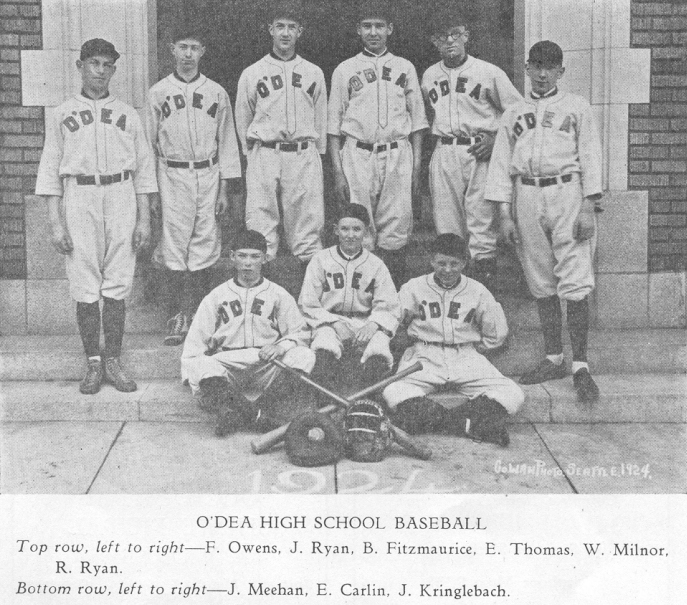
O’Dea’s Baseball Team, 1924. The young man on the far right is Russell G. Ryan, Father Ryan’s father, who was a member of O’Dea’s very first graduating class
A s the signs and banners around O’Dea High School proclaim, O’Dea is renowned for its Catholic tradition, its brotherhood, its academics, and, of course, its athletics. As O’Dea marks 100 years of service, let’s take a look back at its history which is inseparable from the history of St. James Cathedral. The Cathedral Parish has had a strong commitment to education from the very beginning. In 1910, just three years after the Cathedral’s dedication and with a debt of $150,000! Cathedral parishioners took on an additional burden of $30,000 to build a parish school. By 1914, enrollment had reached 400, and high school classes were added.
With the arrival of Father James Gordon Stafford as Cathedral pastor in 1919, the Cathedral entered a new era. An extraordinarily effective fundraiser, Father Stafford’s first order of business was to reduce the parish’s massive debt. In 1920, he launched a fundraising campaign, which was so successful that $90,000 was raised in short order, and the debt almost eliminated.
Under Father Stafford’s leadership, the Cathedral School continued to grow. Through the generous support of the Cathedral Parish and the outstanding service of the Sisters of the Holy Names of Jesus and Mary anyone, Catholic or non-Catholic, could attend Cathedral School at no cost. Bus service was provided, allowing students from all over the city to attend. Even textbooks were free. No wonder the school continued to grow, reaching a peak enrollment of 600. Cathedral Hall was divided into four classrooms. Even the north sacristy of the Cathedral was used as classroom space!
It was clear that something needed to be done, and Father Stafford had a plan. “For four years, Fr. Stafford had longed for a Boys’ High School and now was the time to act. And with the determination that this great parish should offer our young men an institution of learning equal to anything in the country, he planned a structure of outstanding beauty and usefulness. He did this in spite of the burden of over a quarter million dollars which the whole undertaking would place upon him and upon his people” (Silver Jubilee History of St. James Catheral).
Father Stafford purchased a half-block behind the Cathedral for $43,000. While Bishop Edward O’Dea opened discussions with the Irish Christian Brothers about staffing the school, Father Stafford worked closely with Beezer Brothers Architects on the design. They erected a stately building in Tudor collegiate Gothic style, with eight classrooms and a rooftop gymnasium. Classes began on September 4, 1923, with 166 students. Students met in portables until the new building was blessed on March 16, 1924. The school was named to honor Bishop Edward J. O’Dea, who had served the diocese since 1896.
In the school’s early years, curriculum was straightforward: all students had four years of Latin, English, chemistry, physics, and mathematics. But from O’Dea Celebrates 100 Years Happy Birthday to a First Hill Institution Corinna Laughlin is Director of Liturgy at St. James Cathedral and unofficial diocesan historian. O’Dea’s Baseball Team, 1924. The young man on the far right is Russell G. Ryan, Father Ryan’s father, who was a member of O’Dea’s very first graduating class. In Your Midst December 2023 13 the beginning, there were plenty of other activities to get involved in. Football, baseball, basketball, handball, ski club, and theater were all popular. Later on, debate was added. There were even clubs for harmonica and tap dancing!
O’Dea students became a fixture of the First Hill neighborhood. They flocked to the soda fountains, and flooded First Hill during their lunch break. This got them in trouble with Bishop Shaughnessy, who succeeded Bishop O’Dea in 1935. Bishop Shaughnessy enumerated their offenses in a sternly worded letter to the principal: blocking access to the sidewalk at Terry and Marion, standing on the lawn in front of Cabrini Hospital, and generally making a lot of noise. The young president of the student body, wrote an abject apology: “We are all exceedingly sorry and while praying for forgiveness, we promise there shall not be a repetition of the things of which you complain.”
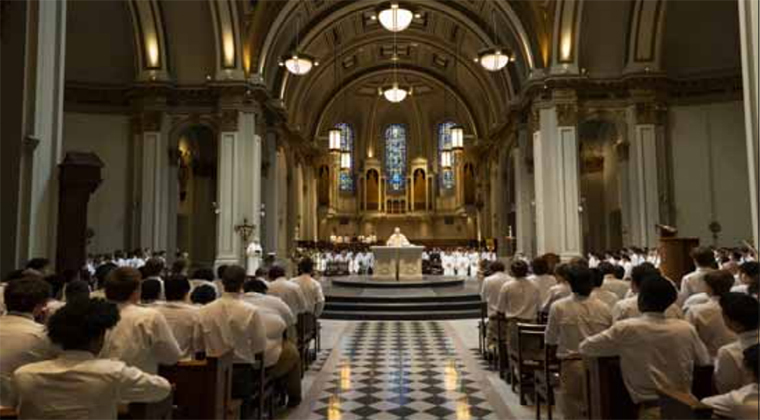
The O’Dea community gathers in the Cathedral for Mass many times each year. (Photo courtesy Amanda Miccile, O’Dea High School.)
The Great Depression hit O’Dea hard. In 1931, 176 of the 305 students were unable to pay the tuition of five dollars a month, and the Cathedral Parish struggled to make ends meet. There was serious consideration of handing the school over to the Christian Brothers entirely. But, in spite of the challenges, the Cathedral Parish renewed its commitment to O’Dea. A newly-formed O’Dea Mothers Club undertook to raise additional funds.
In 1936, the first yearbook, the Olympian, appeared. Alongside formal portraits of each senior the yearbook listed their parish and their O’Dea activities, along with their nicknames: Doc, Woody, Jumbo, Bus, Chaucer, Griff, Skippy, Stork, Bud, Speed, Howie, Wee Willie, Murph, Ollie, Sak, Porky, and Scoops. They also included their Class Legacy: “We, the class of 1936, having been students at O’Dea High School, Marion and Terry, Seattle, in the Commonwealth of Washington, Union of States of America, Western Hemisphere, solar system, do hereby bequeath, give away, and force others to take such sundry, useless things as have no use for us any more, viz., to wit, i.e.: To the Brothers, heartfelt thanks. To the school in general, great relief.”
Over the years, O’Dea has continued to grow. An annex with additional classroom space was built in 1968, and the Bishop Thomas E. Gill Memorial Gymnasium was added in 1976. Further enhancements have followed. Computers first appeared in classrooms in the 1980s, and in 2023, O’Dea purchased a field for O’Dea athletics the first land owned by the school, and a permanent investment in the future of O’Dea. In the beginning, the faculty was entirely made up of Christian Brothers. Soon, lay teachers joined the faculty. By the 1980s, lay teachers outnumbered the Brothers. In 2013, Jim Walker became the school’s first lay president.
Even without the presence of the Brothers, O’Dea proudly continues in the Christian Brothers’ tradition, treasuring its spiritual connection with the Brothers and with Blessed Edmund Rice, the founder. Today, the School’s four houses are named for four places important in the life of Blessed Edmund: Dublin, Kilkenny, Waterford, and Limerick.
And while the Cathedral Parish no longer funds and runs O’Dea as in the early years, the Cathedral still serves as O’Dea’s “chapel” for monthly student body Masses and its Baccalaureate Mass. In 2018, Father Ryan was awarded an honorary diploma, acknowledging his support for O’Dea over thirty years as Cathedral Pastor.
Congratulations to O’Dea High School on 100 years of service and presence on First Hill. Roll Irish!
Source: In Your Midst Magazine, a publication of St. James Cathedral, Seattle, Washington